Using Stored Expressions
Role: Administrator.
Minimum Version: Neurons for ITSM 2023.4.
An expression is a combination of common mathematical values and Neurons for ITSM proprietary functions. You can use expressions in a search, quick action, dashboard, workflow, or business rule. The power of expressions gives you more control over your results. You can enter text constants, functions, or expression delimiters.
Neurons for ITSM allows you to store expressions for reuse in multiple ways; for example, you can use them in quick actions, searches and dashboards, and styles.
 Using Stored Expressions in Neurons for ITSM
Use Stored Expressions the same way you use expressions. The key difference between using stored expressions and using traditional expressions is that stored expressions can be saved for reuse. For detailed instructions on the use of expressions in different scenarios, please refer to the online help for expressions.
Using the Stored Expressions Workspace
- Access the Stored Expressions workspace from the Build section of the Configuration Console.
- The Stored Expressions workspace provides a list of existing stored expressions.
- Select any of the headings in the workspace to sort stored expressions. These include:
- Name
- Association
- Description
- Type
- Expression
- Modified By, and
- Last Modified
- Click the Edit icon to edit an existing stored expression.
- This opens the details for the stored expression.
- You can modify the description and the expression from this workspace.
- Click Expression to open the Expression Editor.
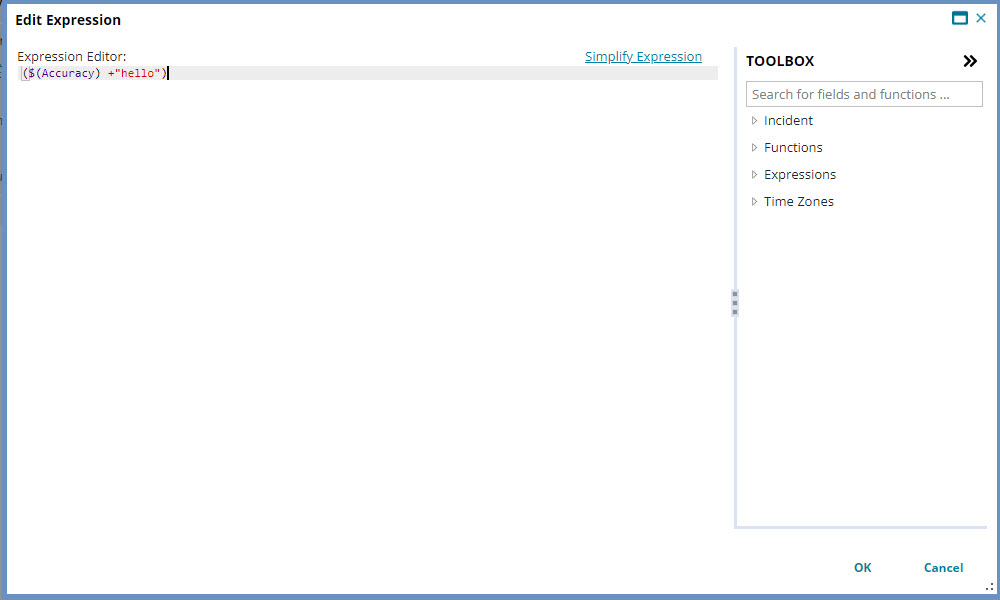
- The Expression Editor toolbox provides a list of relevant fields and functions used to modify the stored expression.
- Write the expression and click Simplify Expression.
- Literals are not supported in stored expressions. Values must be wrapped in $() so they are evaluated correctly. For example, an expression cannot simply be True; rather, it must be $(True).
- See Expression Grammar for detailed instructions on expression syntax and for syntax required for using Stored Expressions.
- Click OK to return to the Stored Expressions workspace.
When you click OK, the Expression Editor automatically validates the expression syntax.
- Click Save to save your edits, or click Cancel to discard any changes.
Access additional help at Using the Expression Editor.
- Use the Filter Association dropdown menu to filter existing stored expressions by their associated business objects.
- Click the Add icon to enter the Expression Editor and create a new stored expression. Detailed information on creating stored expressions can be found in Creating and Deleting Stored Expressions.
- Click the Refresh icon to refresh the list of stored expressions.
Example of creating and using a Stored Expression
This example demonstrates how to create and use a Stored Expression that converts the text to uppercase and trigger it in a quick action to change the text of a description field to uppercase.
Create a Stored Expression
1.Log in to Neurons for ITSM as an Administrator.
2.Go to Configuration console > Build > Stored Expressions.
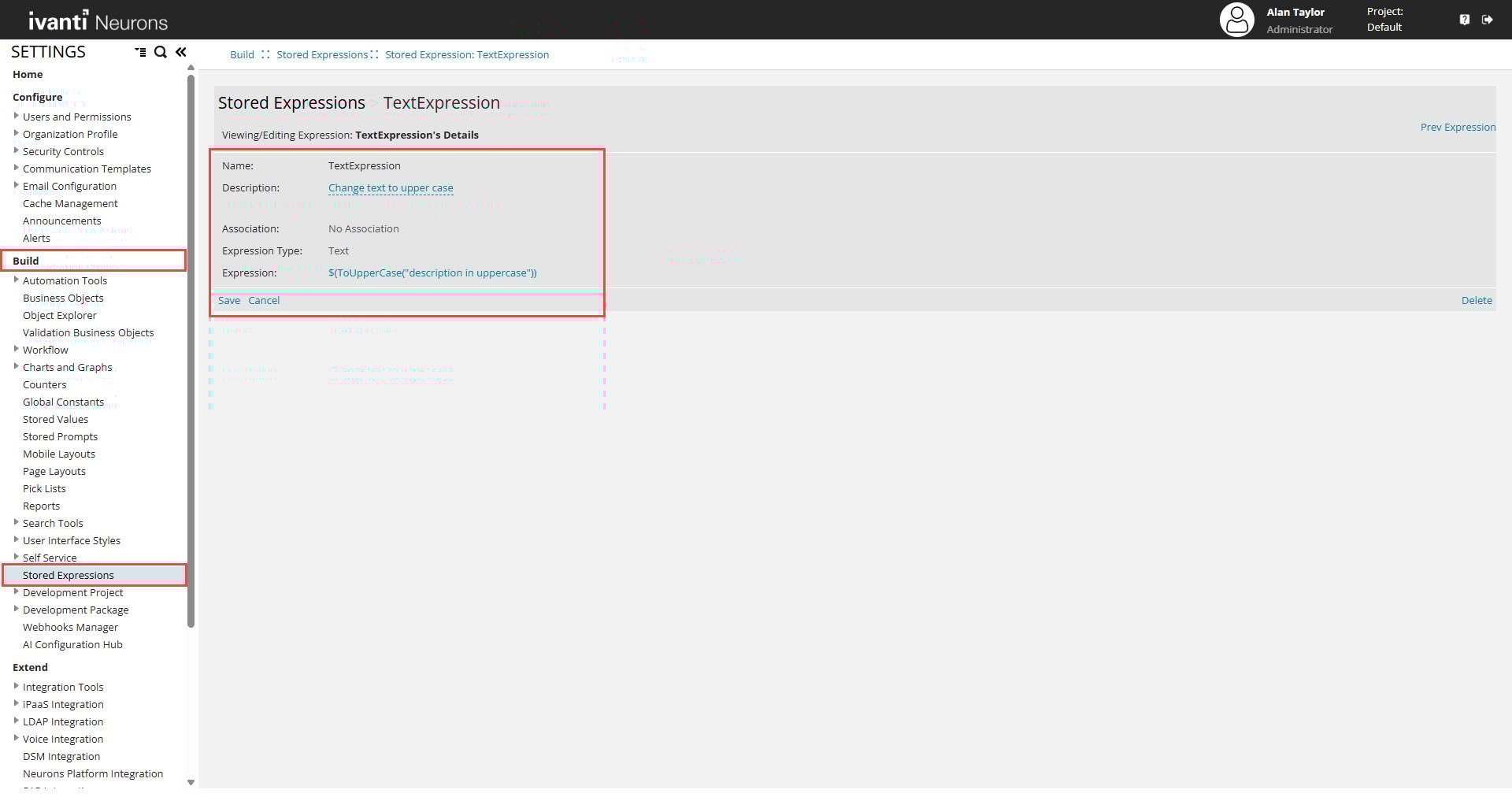
3.Click Add and enter a Name "TextExpression" and Description "Change text to upper case" to the expression.
4.Select No Association from the Association dropdown.
5.Select the Expression Type to Text.
6.Select Expression to open the Expression Editor and do the following:
| a. | Double click or drag the ToUpperCase function in the Expression Editor. |
| b. | Add a text string in lowercase "description in uppercase" to convert to uppercase. |
Using the Stored Expression in a Quick Action
1.Go to Incident workspace, in the Service Desk console.
2.Select More > Edit Actions > Classic Action Designer.
3.Select Create New Actions > Update Object.
| a. | Enter Action Name as "TestStoredExpression" and select the Field Name as Symptom (Description). |
| b. | Select the fx button to add the Stored Expression. |
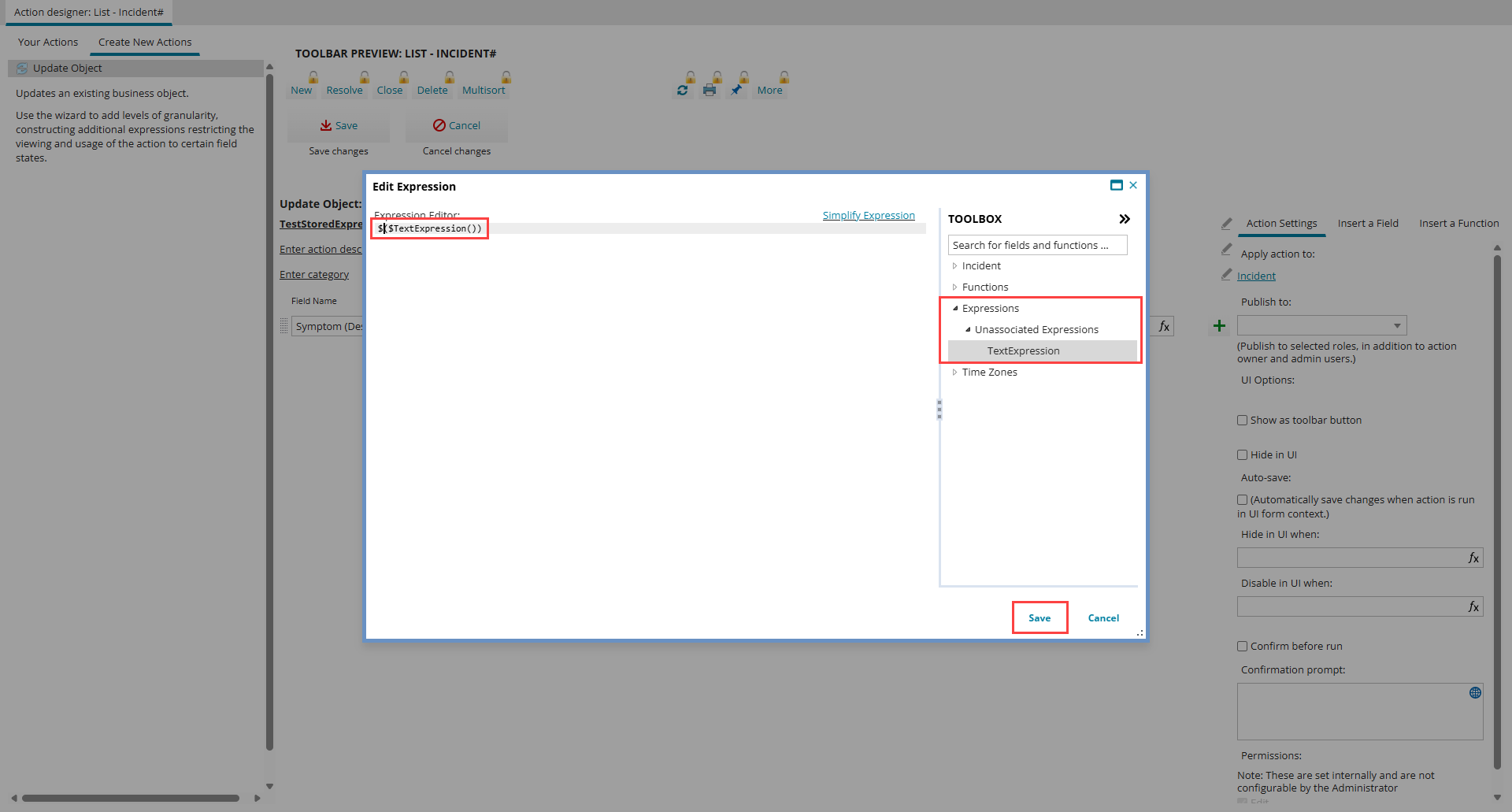
| c. | In the Expression Editor double-click or drag the stored expression "TextExpression" listed under the Unassociated Expressions in the Expressions tab. |
| d. | Edit the expression to $($TextExpression()), select OK, and save the quick action. |
Trigger the Quick Action
Open any Incident, select More > No Category > TestStoredExpression.
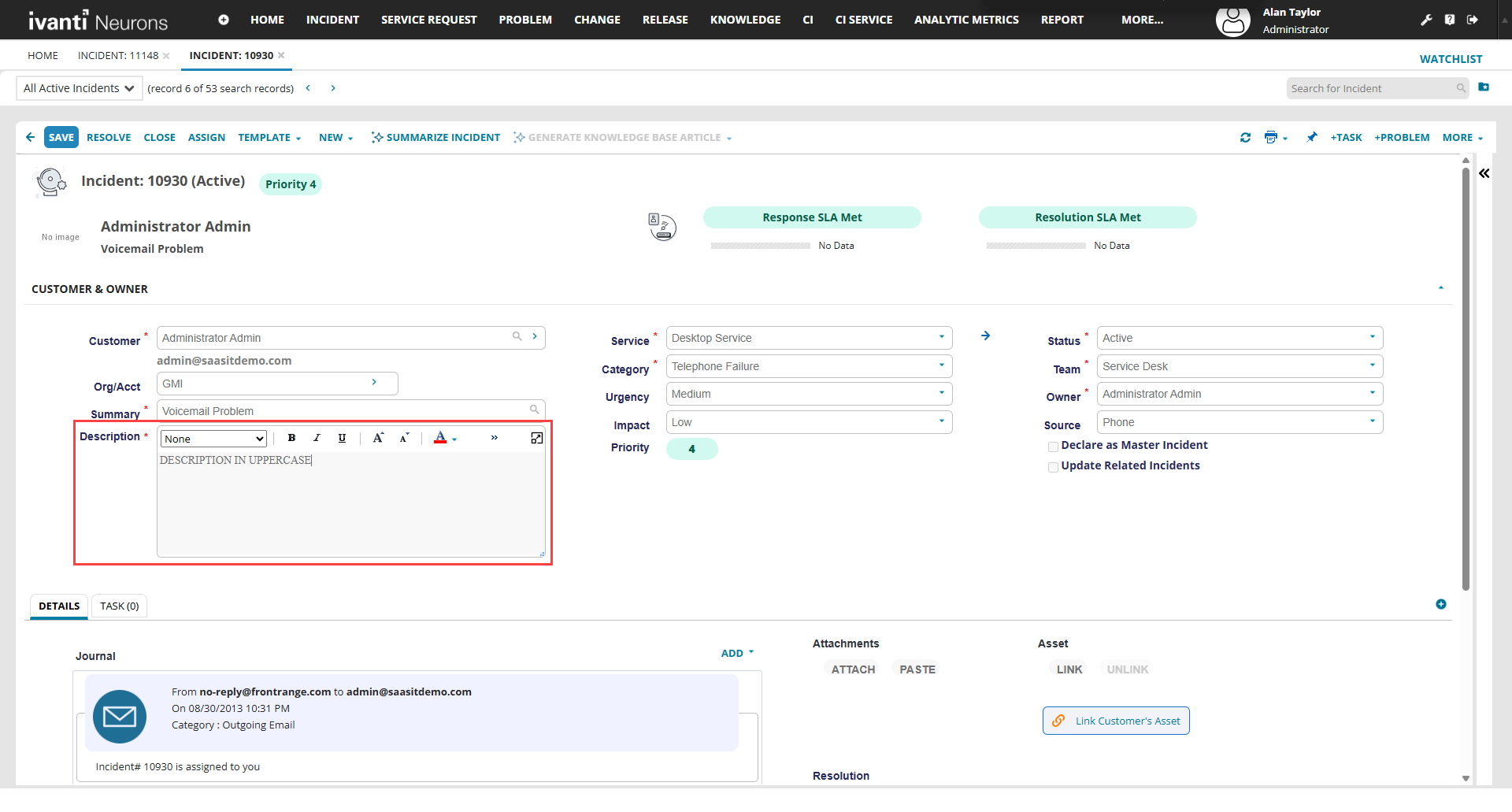
This will trigger the quick action and update the Description field's text to "DESCRIPTION IN UPPERCASE".